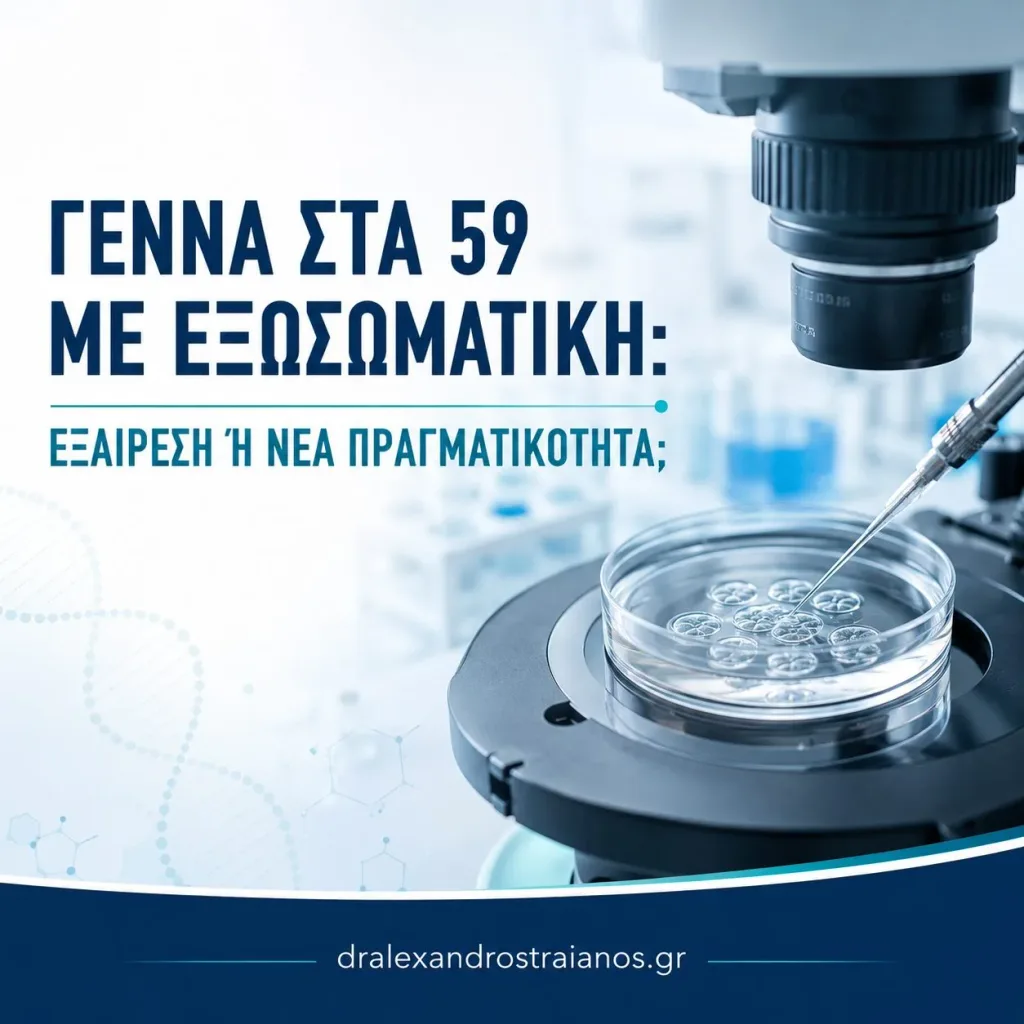
GIVING BIRTH AT 59 AFTER IVF: AN EXCEPTION OR A NEW REALITY?
CONTENTS
Every time a story is published about a pregnancy at the age of 58 or 59, public debate heats up very quickly. Some see it as striking proof of medical progress, others believe that age is no longer a real limitation, while there are also those who regard such cases as extreme examples that should not be presented as the rule.
The reality, however, is more complex. In many of these cases the pregnancy does not arise within the Greek legal and medical framework, but after IVF treatment abroad, in countries where different age limits, different requirements and different practices may apply. This is a crucial point for interpreting such news correctly.
What it means when IVF is carried out outside Greece
In cases of pregnancy at ages such as 58 or 59, it is very likely that the treatment was carried out outside Greece, in a country where the legal framework is different or more flexible. This choice may be linked to different age limits, access to egg donation, different patient acceptance criteria and a different medical or legal approach to assisted reproduction.
The existence of these differences does not mean that the procedure is suitable for every woman, nor that the biological limitations associated with age disappear.
The rules on IVF and age in Greece
In Greece, medically assisted reproduction is governed by a specific legal framework and supervised by the National Authority for Medically Assisted Reproduction. Under Law 4958/2022, the age limit for women who may use methods of medically assisted reproduction was raised from 50 to 54. (eaiya.gov.gr)
For women aged from 50 years and 1 day to 54 years and 0 days, a method of medically assisted reproduction may be used only after a relevant permit from the Authority. (Open Government)
A pregnancy at the age of 59 therefore falls outside the standard Greek framework and is usually linked to treatment carried out in another country.
Why IVF at 59 is an exception
Biological limitations
At this age, the biological limitations are particularly significant. Natural conception is extremely rare, egg quality has declined to a very great extent and, in most such cases, pregnancy is achieved using donor eggs.
ESHRE states that fertility declines noticeably from the mid-30s and that natural pregnancies become rare in the 40s. (eshre.eu)
In other words, this is not a typical IVF treatment, but a specialised scenario that requires very careful medical assessment.
Obstetric and medical risks
Pregnancy at an advanced age is associated with increased obstetric and medical risks. These include gestational hypertension, gestational diabetes, a higher likelihood of caesarean section and a greater strain on the mother's body.
According to the ASRM, advanced maternal age is a risk factor for infertility, pregnancy loss, fetal anomalies, stillbirth and obstetric complications. (American Society for Reproductive Medicine)
These risks are not fully eliminated even when eggs from a young donor are used. The age of the woman carrying the pregnancy still plays an important role in the course and safety of the pregnancy.
Is this the new reality?
The answer is not clear-cut. On the one hand, modern reproductive medicine has indeed extended the limits of fertility and has offered solutions to women who in the past would not have had such options.
On the other hand, this does not mean that age no longer affects fertility, that the procedure is low-risk, or that such cases are an option for the general population.
The ASRM states that egg donation can largely overcome the age-related decline in implantation and birth rates, but this does not cancel out the risks associated with pregnancy at an advanced age. (American Society for Reproductive Medicine)
Pregnancies at such an advanced age should be treated as exceptional cases that require rigorous medical assessment, counselling and monitoring.
The danger of the wrong comparison
The biggest problem with such news is that it can create false expectations. A woman aged 43, 45 or 48 may think: "If it can happen at 59, I still have time."
This, however, is misleading. In reality, fertility already declines significantly after 35, the chances of success fall as age increases, and the risks to the mother and the pregnancy rise progressively.
HFEA data show that pregnancy rates per embryo transfer using a woman's own eggs are clearly lower at older ages, with women aged 43-44 having much lower rates than younger age groups. (HFEA)
Exceptional cases should not be confused with the rule. Every woman needs personalised advice based on her age, her history, her test results and her personal goals.
The key points
IVF that leads to a pregnancy at 59 is a medical exception, not the new normal. Modern reproductive medicine can broaden the possibilities, but it does not abolish biology, it does not eliminate the risks and it is not applied in the same way in every case.
Good information, a realistic assessment and a personalised medical approach remain the essential elements of safe and responsible assisted reproduction treatment.
Important note
This article is for information only and does not replace an individual medical assessment. The choice of treatment, country, timing and method should always be made together with a specialist in reproductive medicine.
Useful sources
National Authority for Medically Assisted Reproduction – Amendment of Medically Assisted Reproduction Legislation / Law 4958/2022. (eaiya.gov.gr)
National Authority for Medically Assisted Reproduction – Supporting documents for the age limit extension 50-54. (eaiya.gov.gr)
OpenGov – Amendment of articles of Law 3305/2005 regarding the 50-54 age range and the Authority's permit. (Open Government)
ASRM – Assisted Reproduction with Advancing Paternal and Maternal Age: Ethics Committee Opinion, 2025. (American Society for Reproductive Medicine)
ASRM / Fertility and Sterility – Oocyte or Embryo Donation to Women of Advanced Reproductive Age. (PubMed)
ESHRE – Female Fertility and Age. (eshre.eu)
HFEA – IVF Treatment Key Facts and Statistics. (HFEA)

He supports scientific excellence in clinical practice and recognizes the possibilities offered by modern reproductive methods to couples who wish to have a child of their own.
His profileThe content of this article is for information only and does not replace a medical examination and advice.