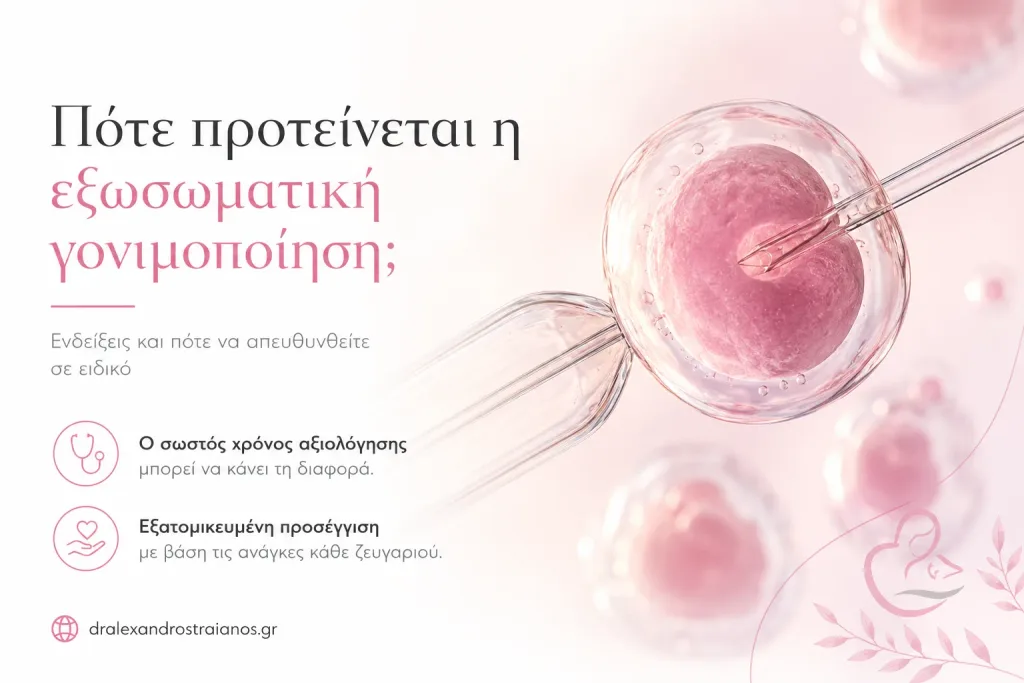
When Is IVF Recommended? Indications and When to See a Specialist
CONTENTS
- Key points
- When is in vitro fertilization needed, and when is a conception difficulty considered to exist?
- IVF is not always the first option
- The most common cases in which IVF is recommended
- Age plays an important role
- When should you consult a specialized gynecologist?
- Conclusion
- Frequently asked questions
- 1A fertility assessment is recommended after about 12 months of trying under the age of 35, and after about 6 months from the age of 35 onwards.
- 2IVF is not always the first choice; a full fertility work-up comes first.
- 3Common indications are blocked fallopian tubes, male factor, endometriosis, diminished ovarian reserve and unexplained infertility.
- 4The woman's age plays an important role, which is why assessment should not be delayed.
- 5Seeing a specialist early does not necessarily mean you will need IVF.
When in vitro fertilization is needed is determined by age, the duration of attempts and the findings of the fertility assessment, as it is not always the first option. It is recommended when there is difficulty conceiving, a specific cause of infertility, or when other methods have not been successful. Early evaluation by a specialist helps determine the right time for treatment.
One of the most frequent questions that arise at this stage is whether the time has come to consider in vitro fertilization. Many people mistakenly believe that IVF is the only or the immediate solution in every case of infertility. In reality, this is not the case.
In vitro fertilization is one of the most important methods of assisted reproduction, but it is not applied to all couples, nor is it always the first step. The decision is based on many factors, such as the woman's age, the duration of attempts, the results of tests and the cause of infertility.
In this article we will look at when in vitro fertilization is recommended, what the most common indications are, and when it is the right time to consult a specialized gynecologist.
When is in vitro fertilization needed, and when is a conception difficulty considered to exist?
Not every delay in achieving pregnancy means that there is a fertility problem.
In most healthy couples, pregnancy may take several months to be achieved, even when there is no pathological cause.
In general, an evaluation is recommended when:
the woman is under 35 years of age and pregnancy has not been achieved after approximately 12 months of regular unprotected intercourse,
the woman is 35 years of age or older and pregnancy has not been achieved after approximately 6 months of attempts,
there are known fertility problems or specific medical conditions, in which case the assessment may be needed earlier.
Early evaluation helps identify possible causes and allows proper planning of the management approach.
IVF is not always the first option
One of the biggest mistakes is the perception that every couple with difficulty conceiving needs IVF.
In reality, before this decision is made, a complete fertility investigation takes place. Depending on the findings, different treatment options may be proposed, such as cycle monitoring, ovulation induction or intrauterine insemination.
IVF is recommended when it is estimated to offer the best chances of achieving pregnancy, or when other methods are not suitable or have not been successful. For more information about the procedure, see in vitro fertilization.
The most common cases in which IVF is recommended
Fallopian tube obstruction or severe damage
The fallopian tubes are essential for natural fertilization. When there is obstruction or significant damage, the meeting of the egg and the sperm becomes difficult or impossible.
In these cases, IVF is often the most effective solution.
Male factor infertility
Sperm quality plays a decisive role in natural conception.
When the semen analysis shows significant abnormalities in the count, motility or morphology of the sperm, IVF can significantly increase the chances of fertilization. In some cases, intracytoplasmic sperm injection (ICSI) is also applied.
Endometriosis
Endometriosis is a chronic gynecological condition that can affect the function of the ovaries and fallopian tubes, as well as fertility.
Depending on the severity of the disease, the woman's age and the duration of infertility, the gynecologist may recommend IVF as the most suitable option.
Diminished ovarian reserve
Over time, both the number and the quality of eggs naturally decline.
The assessment of ovarian reserve through specialized tests helps in treatment planning and may lead to the decision for IVF, particularly when time is an important factor.
Unexplained infertility
In some couples, despite complete laboratory and imaging evaluation, no specific cause of infertility is identified.
When pregnancy is still not achieved after a reasonable period of time or after other treatment attempts, IVF may be the next option.
Repeated unsuccessful attempts
IVF may also be recommended when:
previous intrauterine inseminations have been unsuccessful,
there are repeated difficulties in conceiving,
specific genetic planning is required,
there are other individualized medical indications.
Age plays an important role
One of the most important factors taken into account is the woman's age.
After the age of 35, fertility gradually begins to decline, while after 40 the probability of natural conception decreases even further.
This does not mean that every older woman needs IVF immediately, but that evaluation should not be delayed. If you would like to see when age makes the difference, read the article on IVF after the age of 45.
An early visit to the specialist allows the selection of the most suitable strategy before valuable time is lost.
When should you consult a specialized gynecologist?
The advice of a specialist is important when:
pregnancy attempts have not been successful,
there are menstrual cycle disorders,
there is a history of endometriosis,
previous miscarriages have occurred,
there are known problems in the semen analysis,
there is diminished ovarian reserve,
there is a family history of premature menopause.
Early evaluation does not necessarily mean that IVF will be needed. However, it does mean that the couple will receive individualized guidance and will know what their real options are.
Conclusion
In vitro fertilization is not always the first step in the management of infertility, but in many cases it can offer the best prospect of achieving pregnancy. The decision is based on the overall evaluation of the couple, taking into account age, medical history and the causes of the difficulty in conceiving. Early advice from a specialized gynecologist, such as Dr. Alexandros Traianos, can help in properly planning the next steps and in choosing the most suitable approach for each couple.
Sources: For general information about infertility and treatment options, see the WHO fact sheet on infertility.
What patients often ask
No. Depending on the cause of the difficulty in conceiving, there may be other treatment options.
In some cases yes, especially when there are known factors that significantly reduce fertility.
Yes. Although the woman's age is usually the most important factor, the man's age can also affect sperm quality and fertility.
The decision is made after a comprehensive assessment of the couple and an individual discussion with the specialist gynaecologist.

He supports scientific excellence in clinical practice and recognizes the possibilities offered by modern reproductive methods to couples who wish to have a child of their own.
His profileThe content of this article is for information only and does not replace a medical examination and advice.