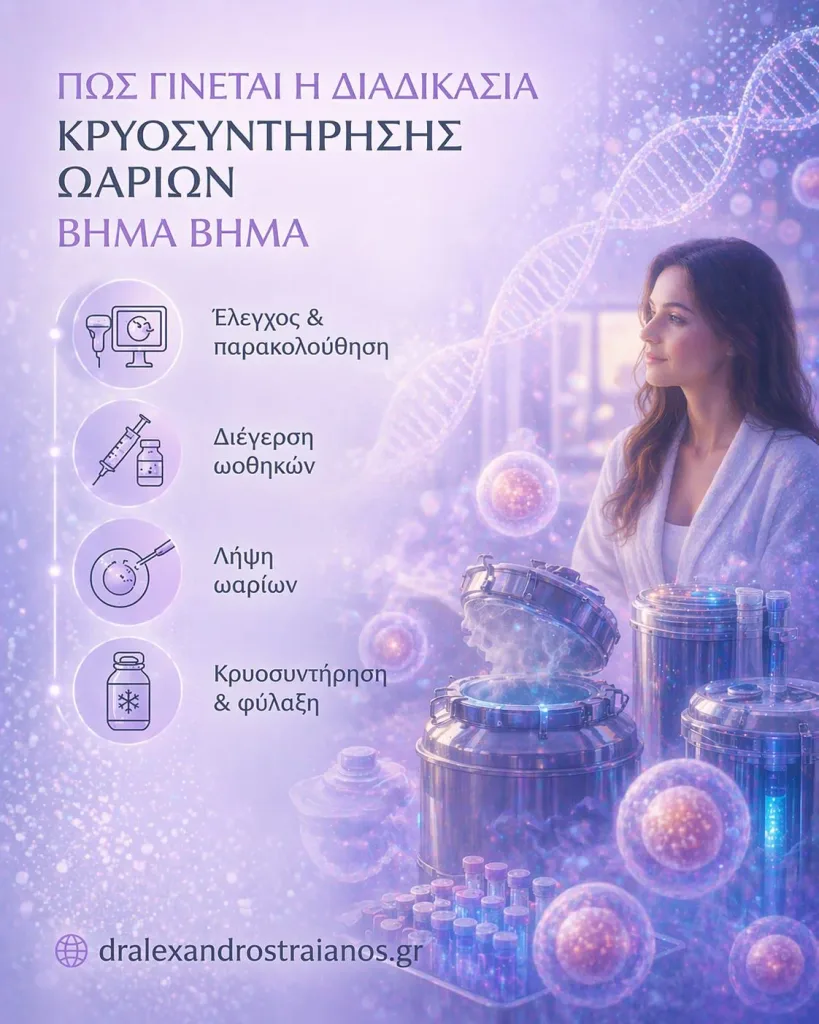
HOW EGG CRYOPRESERVATION IS DONE STEP BY STEP
CONTENTS
- Initial tests and fertility assessment
- Hormonal ovarian stimulation
- Egg retrieval – collecting the eggs
- Assessment and selection of mature eggs
- Cryopreservation with modern rapid-freezing techniques
- Safe storage for future use
- Conclusion – An organised and safe fertility procedure
- Specialist fertility care in Thessaloniki by Dr. Alexandros Traianos at the Centre for Reproductive Medicine and Fetal Medicine
Egg freezing is a modern, safe and well-organised procedure for preserving female fertility. In Thessaloniki it is carried out with scientific precision and individual planning, giving women the opportunity to protect their fertility for the future. Although it sounds complex, in practice the procedure follows clear, controlled steps that usually take a few weeks.
Initial tests and fertility assessment
The process begins with a full medical work-up that includes:
- hormone blood tests
- ultrasound scan of the ovaries
- assessment of ovarian reserve
- a detailed medical history
Based on these findings, the right protocol is designed for each woman, so that the procedure is safe and effective.
Hormonal ovarian stimulation
For about 8 to 12 days, special medications are given that:
- stimulate the ovaries to produce more eggs
- increase the number of eggs that will be collected
- are closely monitored with ultrasound scans and blood tests
This phase is painless and fully controlled by the medical team.
Egg retrieval – collecting the eggs
Egg retrieval is performed:
- under light sedation
- in about 15–20 minutes
- without a surgical incision
- under ultrasound guidance
The eggs are carefully collected from the ovaries and taken straight to the laboratory.
Assessment and selection of mature eggs
In the embryology laboratory:
- the quality of the eggs is checked
- the mature, healthy eggs are selected
- they are prepared for freezing
This phase is decisive for the future success of the procedure.
Cryopreservation with modern rapid-freezing techniques
The eggs are frozen by vitrification, which:
- prevents ice crystals from forming
- preserves their structure excellently
- offers high survival rates after thawing
They are stored in liquid nitrogen at extremely low temperatures, ensuring maximum safety.
Safe storage for future use
The eggs can remain:
- in cryopreservation for many years
- without any loss of quality
- in complete safety and under monitoring
Whenever the woman wishes, they can be thawed and used for assisted reproduction.
Conclusion – An organised and safe fertility procedure
Egg freezing is a carefully controlled procedure that combines cutting-edge medical technology with personalised care. With proper preparation and scientific guidance, it offers excellent chances of a future pregnancy and peace of mind to women who choose to protect their fertility.
Specialist fertility care in Thessaloniki by Dr. Alexandros Traianos at the Centre for Reproductive Medicine and Fetal Medicine
At the Centre for Reproductive Medicine and Fetal Medicine in Thessaloniki, every stage of egg freezing is carried out using modern techniques and strict safety protocols. Under the guidance of Dr. Alexandros Traianos, every woman receives personalised information, responsible monitoring and the best possible chances of success.

He supports scientific excellence in clinical practice and recognizes the possibilities offered by modern reproductive methods to couples who wish to have a child of their own.
His profileThe content of this article is for information only and does not replace a medical examination and advice.