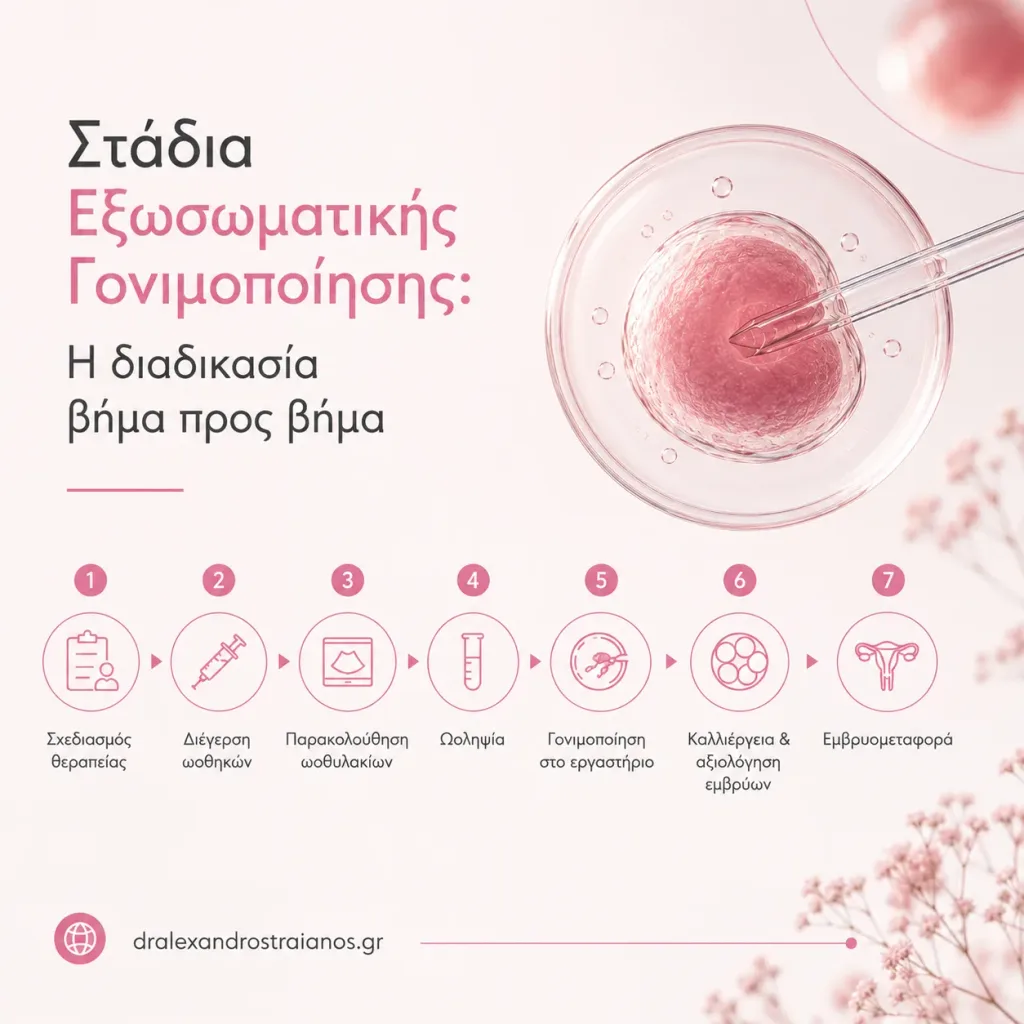
STAGES OF IN VITRO FERTILIZATION: THE PROCESS STEP BY STEP
CONTENTS
- Key points
- Stage 1: Treatment Planning
- Stage 2: Ovarian Stimulation
- Stage 3: Monitoring Follicle Development
- Stage 4: Egg Retrieval
- Stage 5: Fertilization in the Embryology Laboratory
- Stage 6: Embryo Culture and Evaluation
- Stage 7: Embryo Transfer
- Stage 8: The Wait Until the Pregnancy Test
- Every Treatment Is Different
- Frequently Asked Questions
- Conclusion
- Frequently asked questions
- 1IVF proceeds in eight main stages, from treatment planning to the pregnancy test.
- 2Ovarian stimulation usually lasts 8 to 12 days and is monitored with ultrasound scans and blood tests.
- 3Egg retrieval takes about 15–20 minutes, is usually performed under light sedation and the woman goes home the same day.
- 4Embryo transfer is short, usually painless and does not require anaesthesia.
- 5Every treatment protocol is designed individually.
The decision of a couple to proceed with in vitro fertilization (IVF) is often accompanied by many questions. One of the most common is how exactly the procedure is carried out and what each of its stages involves.
Although IVF may initially appear complicated, it is in fact an organized and personalized procedure carried out under continuous medical supervision. Each stage has a specific purpose and is planned according to the needs of each couple.
Knowing the steps of the treatment helps prospective parents feel more secure, know what to expect, and take an active part throughout the process.
In this article, we present in detail the stages of in vitro fertilization, from the start of treatment through to the embryo transfer and the wait for the result.
Stage 1: Treatment Planning
Before any medication is started, an assessment of the couple takes place first.
The gynecologist reviews:
- the medical history,
- the woman's age,
- the ovarian reserve,
- the semen analysis,
- hormonal tests,
- any previous attempts at assisted reproduction.
Based on this information, a personalized treatment plan is created.
Stage 2: Ovarian Stimulation
The procedure begins with the administration of specific hormonal medications that stimulate the ovaries so that more follicles develop.
The goal is to collect more mature eggs, thereby increasing the chances of creating healthy embryos.
The duration of this stage is usually 8 to 12 days, depending on each woman's response.
Stage 3: Monitoring Follicle Development
During stimulation, ultrasound scans and blood tests are performed regularly.
In this way, the gynecologist evaluates:
- the development of the follicles,
- hormone levels,
- the response of the ovaries to treatment.
If necessary, the treatment protocol is adjusted in order to achieve the best possible result.
Stage 4: Egg Retrieval
When the follicles reach the appropriate size, egg retrieval is scheduled.
It is a brief procedure performed transvaginally, under ultrasound guidance and usually with light sedation.
It lasts approximately 15–20 minutes, and the woman returns home the same day.
Stage 5: Fertilization in the Embryology Laboratory
After egg retrieval, the sperm sample is collected.
In the laboratory, the eggs are fertilized either with the conventional method or with intracytoplasmic sperm injection (ICSI), when there is a relevant indication.
Subsequently, the embryologists monitor the development of the embryos daily.
Stage 6: Embryo Culture and Evaluation
The embryos remain for a few days in special incubators that reproduce natural conditions as closely as possible.
The following are evaluated daily:
- morphology,
- rate of development,
- quality,
- the developmental potential of each embryo.
Based on these data, the appropriate embryo is selected for transfer.
Stage 7: Embryo Transfer
Embryo transfer is the final stage of the procedure.
With the help of a very thin catheter, the embryo is carefully placed inside the uterus.
The procedure:
- is brief,
- does not require anesthesia,
- is usually painless,
- is completed within a few minutes.
After it is completed, the woman returns to her daily activities, following the gynecologist's instructions.
Stage 8: The Wait Until the Pregnancy Test
After the embryo transfer, a waiting period follows until the measurement of beta-hCG (human chorionic gonadotropin).
This is a stage with strong emotional intensity, as the couple waits to learn the result of the attempt.
The assessment is made by a blood test on the date set by the attending physician.
Every Treatment Is Different
Although the basic stages of IVF are common, each treatment protocol differs.
Age, history, ovarian reserve, and the cause of infertility significantly influence the planning of the treatment.
For this reason, no two cases are exactly alike.
Frequently Asked Questions
How long does the whole procedure take?
An IVF cycle is usually completed within approximately two to four weeks, depending on the treatment protocol.
Are all the stages painful?
Most women describe the procedure as well tolerated. Egg retrieval is usually performed under sedation, while embryo transfer is painless.
Can the procedure be interrupted?
In some cases, if the response of the ovaries is not as expected or if specific medical indications arise, the gynecologist may modify or postpone the cycle.
When do we know whether the IVF was successful?
Confirmation is made with a beta-hCG blood test, according to the instructions of the attending physician.
Conclusion
In vitro fertilization is an organized, safe, and personalized procedure that includes successive stages, each of which contributes to creating the best possible conditions for achieving a pregnancy. Proper information and close cooperation with a specialized gynecologist, such as Dr. Alexandros Traianos, help the couple approach each step with greater confidence and trust.
What patients often ask
An IVF cycle is usually completed within about two to four weeks, depending on the treatment protocol.
Most women describe the procedure as well tolerated. Egg retrieval is usually performed under sedation, while embryo transfer is painless.
In some cases, if the ovarian response is not as expected or specific medical indications arise, the gynaecologist may modify or postpone the cycle.
Confirmation is by a beta-hCG (human chorionic gonadotropin) test, following the instructions of the treating doctor.

He supports scientific excellence in clinical practice and recognizes the possibilities offered by modern reproductive methods to couples who wish to have a child of their own.
His profileThe content of this article is for information only and does not replace a medical examination and advice.