NON INVASIVE PRENATAL TEST (NIPT)
CONTENTS
Book an appointment
Discuss your case with the physician and find out what the next steps are.
This is a recent method in which cell-free fetal DNA in the mother's circulation can be detected in a blood sample taken from the 10th week of pregnancy.
What is NIPT useful for?
Based on current evidence and the limitations of the test, we recommend it mainly to women at "intermediate" risk, i.e. when the nuchal translucency screening has shown a risk of 1:250-1:1000 and provided that the nuchal translucency is within normal limits. In these cases we use NIPT because we want something more reliable than nuchal translucency screening, but the findings are not worrying enough to recommend invasive testing (amniocentesis or CVS). Conversely, if the nuchal translucency is abnormal (increased), NIPT is not the right test for you and amniocentesis or chorionic villus sampling is recommended.
The American College of Obstetricians and Gynecologists (ACOG) extends the recommendation for chromosomal screening to other cases at "high risk" of chromosomal abnormalities, which include women over 35 or with a relevant medical history.
Finally, the test is also offered to any pregnant woman who simply wishes to have it, without belonging to any of the groups above.
How is it done?
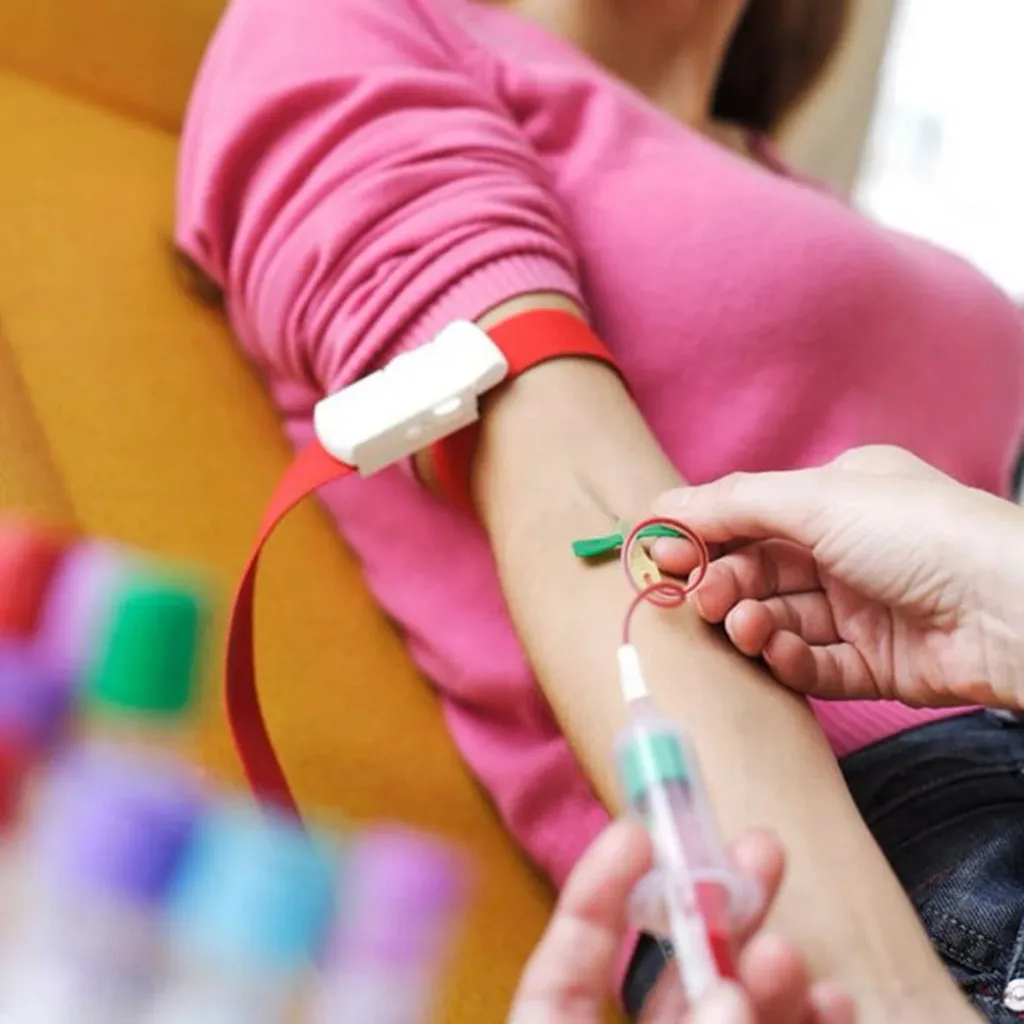
It is a simple blood test taken from the woman's arm, like any other blood test. At present there are no laboratories in Greece that analyse the sample, so it is packaged and sent to the USA.
When is it done?
Ideally, the best time to have the test is at around 11 weeks. At 12 weeks the detailed first-trimester scan with nuchal translucency measurement follows, and the results are assessed together. In practice, however, it can be done at any stage of pregnancy.
When can we expect the result?
Results are usually available within 10-14 days. There is about a 5% chance of not obtaining a result. This does not mean a positive or negative result: it is a failed test, mainly due to low fetal DNA in the mother's blood. A repeat test will be offered free of charge.
How is the result expressed?
The result is expressed as a probability. It is a screening test (SCREENING TEST) and not a diagnostic test. A low-risk result means that the risk of a chromosomal abnormality is lower than 1:10000 and that in >99% of cases the fetus does not have the chromosomal abnormalities above. A high-risk result means that in >99% of cases the fetus will have trisomy 21, 18 or 13, and in this case an invasive test will be offered to confirm the result.
How does it differ from amniocentesis?
In medicine there are diagnostic tests, which will confirm or rule out a condition with 100% certainty, and screening tests, which estimate the probability – in other words the risk – that a condition is present. Screening tests may be more or less accurate in their estimates. For example, a very good screening test is the Pap test, which essentially estimates the likelihood of cervical cancer. It is followed by the diagnostic test, i.e. a cervical biopsy and other investigations.
Where does NIPT stand?
That remains to be determined!
It is certainly a BETTER screening test than measuring nuchal translucency and PAPP-A, since the sensitivity of the method reaches 99% (compared with 96%). In addition, the screening covers trisomies 18 and 13 (as nuchal translucency screening does), as well as, at present, 7 further genetic syndromes depending on the company. It is not, however, a diagnostic test. Neither, for that matter, is the nuchal translucency measurement.
In other words, if NIPT shows a low risk of Down syndrome, the probability of it being present is minimal, and if the risk is increased, confirmation is needed with a diagnostic test, i.e. amniocentesis or CVS (chorionic villus sampling – placental biopsy).
In countries with organised public health systems, such as the United Kingdom, screening tests are sought for the general population, since these determine the subgroups who will go on to have diagnostic tests. The aim is to identify a condition early and to prevent it with public health in mind, as well as at the lowest possible cost.
That is why a screening test should be simpler and cheaper than the diagnostic one. This is not the case – at least not yet – with NIPT, which requires very advanced technology and is just as expensive as amniocentesis and CVS.
The trend appears to be towards a statistical model that will combine the findings of the nuchal translucency scan with NIPT (once, over time, it becomes considerably cheaper) to identify the very few women who will need to undergo amniocentesis or CVS.
NIPT DOES NOT REPLACE AMNIOCENTESIS
AMNIOCENTESIS CANNOT BE PERFORMED INDISCRIMINATELY OR ON LOOSE CRITERIA, BECAUSE IT CARRIES A SMALL BUT REAL RISK OF MISCARRIAGE
Related articles
- Fertility AssessmentNIPT: WHAT IS FREE FETAL DNA TESTING AND WHEN IS IT NEEDED IN PREGNANCY
- Short postsFETAL MEDICINE
- Informative ArticlesPREGNANCY TEST FOR DOWN SYNDROME




He supports scientific excellence in clinical practice and recognizes the possibilities offered by modern reproductive methods to couples who wish to have their own child.
His profileThis information is for general guidance only and does not replace a medical examination and advice.
