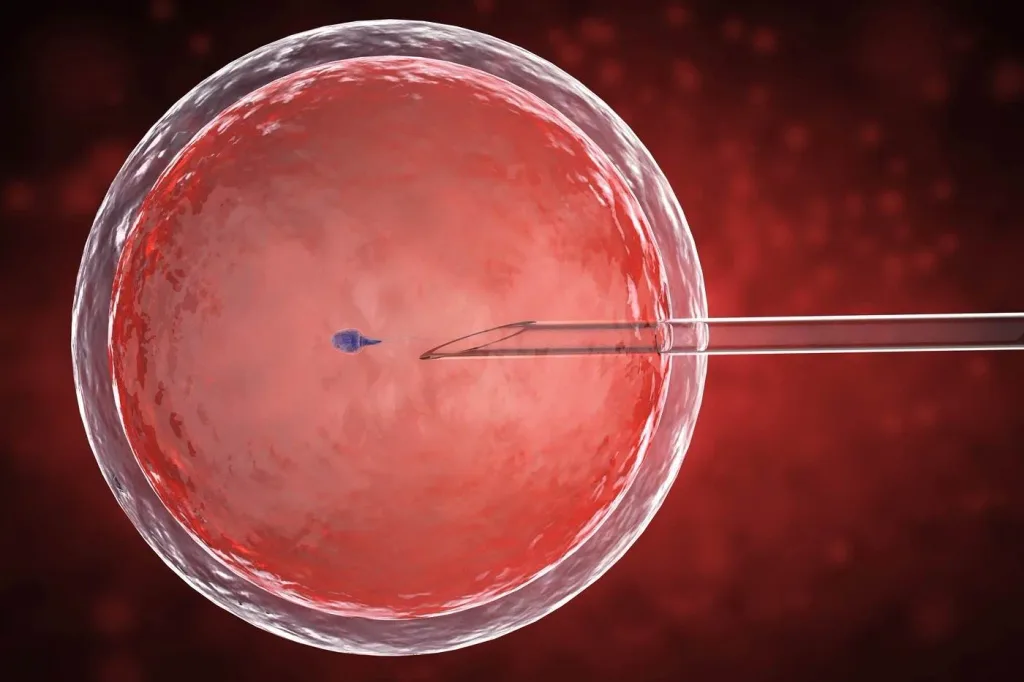
IVF IN NATURAL CYCLE
Book an appointment
Discuss your case with the physician and find out what the next steps are.
The first successful IVF attempt in Manchester in 1978 was by the natural cycle method. Although over the years the use of ovarian stimulation medications has changed a lot, in recent years the natural cycle method has become increasingly used as an alternative to medication use.
The natural cycle is the method in which we do not administer drugs to stimulate the ovaries and obtain many eggs, as is done in classical IVF. On the contrary, we are watching the ovary which the woman normally produces herself during the cycle.
Monitoring is done by vaginal ultrasound as well as hormone measurement in the blood. When the follicle is large enough, at about 16-17 mm, then a gonadotropin injection is made for its final maturation (Pregnyl, Ovitrelle) and, after 36-38 hours, the egg is taken. Once the egg is harvested and fertilized, the resulting embryo is placed in the uterus using the classic method of embryo transfer, 2-3 days after egg collection.
The advantage of the natural cycle is that we do not administer any medication to stimulate the ovaries. Although in-person medications have been used for 25 years and do not appear to be responsible for health effects, many women appear reluctant to take injectable hormones. By the natural cycle method, the stage of stimulation is bypassed, and the only drugs used are non-injectable post-ovulation drugs, which aim to improve the chances of embryo implantation in the uterus and achieve pregnancy.
In addition, the main complications of classical IVF are avoided: Ovarian Overstimulation Syndrome and Multiple Pregnancy.
This method is used in women who either cannot take medicines for various medical reasons or have poor response (Poor responders). It can also be used in women who have made multiple failed attempts with poor quality embryos.
The disadvantage of the physical cycle is that the success rates of the method are significantly lower than that of classical IVF using drugs. The chance of finding a good egg during ovulation, fertilizing and developing a good quality embryo in the laboratory is about 50-60%. Once a good quality embryo is transferred, the chance of pregnancy can be as high as 35%, depending on the age of the woman.
In summary, the natural cycle method can be used with quite good success rates either in women who do not wish to take medications to stimulate their ovaries or in women whose response to medication is poor.
What patients often ask
The best way to determine whether IUI or in vitro fertilization is right for you is to consult an experienced fertility specialist. Ultimately, you may know the right decision for you, but specialists can provide recommendations based on your age, your health, and the cause of your infertility. Typically, younger couples see greater success with IUI, so they may be better candidates. However, if fertilization is not successful and multiple rounds of IUI are required, this option can become costly. For this reason, it is important to weigh the costs, benefits, and risks before making your decision.
Related articles
- Short postsIVF IN NATURAL CYCLE
- Assisted ReproductionIUI AND IVF: WHAT IS THE DIFFERENCE?
- Fertility AssessmentARE YOU A CANDIDATE FOR IVF?



He supports scientific excellence in clinical practice and recognizes the possibilities offered by modern reproductive methods to couples who wish to have their own child.
His profileThis information is for general guidance only and does not replace a medical examination and advice.