CHORION VILLUS SAMPLING - CVS
CONTENTS
Book an appointment
Discuss your case with the physician and find out what the next steps are.
This is essentially a biopsy of the placenta in which chorionic villi – its structural components – are sampled. The fetus and the placenta come from the same dividing cell, the fertilised egg, so the chromosomes found in the cells of the placenta are the same as those of the baby.
When is it done?
It is a test performed at 11-15 weeks.
How is chorionic villus sampling performed?
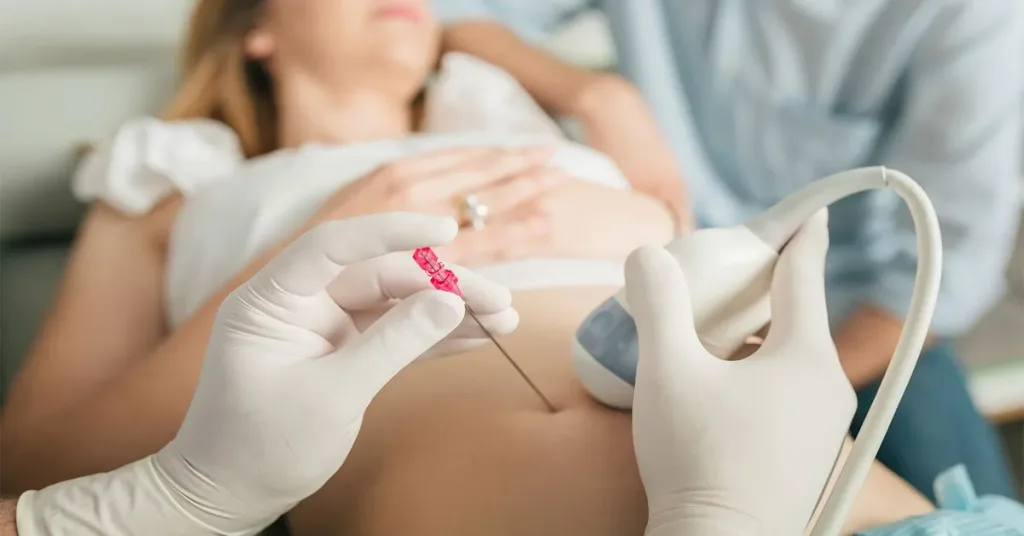
The abdomen is carefully cleaned with antiseptic. The entry point is chosen carefully and a local anaesthetic (xylocaine) is given. A fine needle is then passed through the mother's abdomen into the uterus and the placenta, and a sample of villi is taken by aspiration. The position of the needle is monitored continuously by ultrasound. The procedure takes a few minutes. The needle does not enter the amniotic cavity and does not disturb the fetus. At the end of the test, the fetal heartbeat is checked.
What can I expect after chorionic villus sampling?
For the first 2-3 days you may experience some mild abdominal discomfort, like period pain, or slight vaginal bleeding. These are relatively common symptoms and in the vast majority of cases the pregnancy continues without problems. You can take simple painkillers such as paracetamol (Depon). If you feel a lot of pain, have heavy bleeding or develop a high temperature, seek medical advice.
Is bed rest necessary?
We usually advise bed rest for 1 day and limiting strenuous physical activity for 2-3 days.
Prophylactic anti-D immunoglobulin must not be forgotten for Rh-negative women.
When can I expect the results?
The first results (PCR – 99%) for Down syndrome and other common chromosomal abnormalities are usually available the next day or the day after. The next results (molecular karyotype) for rarer chromosomal abnormalities are available within 1 week. The final result is available 2 weeks after the cell line culture has been completed.
Might the procedure need to be repeated?
In about 1/1000 cases the invasive procedure has to be repeated because the results are unclear, usually because of mosaicism, a situation in which the placenta contains both normal and abnormal cells, sometimes in substantial proportion. The abnormal cells may not involve fetal tissue at all, since nature confined them early on to the placenta alone. In this rare case, amniocentesis must be performed at a later time, as it does not carry the risk of mosaicism.
What are the risks associated with chorionic villus sampling?
The risk of miscarriage due to chorionic villus sampling is about 1/300 and is the same as the risk of amniocentesis after 18 weeks. The risk decreases as the days pass and disappears after the first five days.
Related articles
- Short postsCHORIONIC VILLUS SAMPLING (CVS) - PRENATAL TESTING
- Short postsFETAL MEDICINE
- Informative ArticlesPREGNANCY TEST FOR DOWN SYNDROME




He supports scientific excellence in clinical practice and recognizes the possibilities offered by modern reproductive methods to couples who wish to have their own child.
His profileThis information is for general guidance only and does not replace a medical examination and advice.
