
CROWN AND TRAVEL: WHAT PREGNANT WOMEN AND FAMILIES NEED TO KNOW
Have you planned a trip, or are you wondering whether it is safe to book a family holiday? Here is everything you need to know. It is impossible to go online right now...

OUR NEWS
Articles on infertility, assisted reproduction, fertility testing, and cryopreservation.

Have you planned a trip, or are you wondering whether it is safe to book a family holiday? Here is everything you need to know. It is impossible to go online right now...

Since December 2019, the outbreak of coronavirus disease (COVID-19), which originated in Wuhan, China, has become a global public health threat. On 28 February 2020 the...

Unexplained infertility Unexplained infertility is the condition in which a thorough work-up of an infertile couple fails to establish the cause of this...

COVID-19: FREQUENTLY ASKED QUESTIONS FOR PREGNANT WOMEN There is currently no international evidence that pregnant women are at greater risk than the general population from the new coronavirus (SARS-CoV-2)....

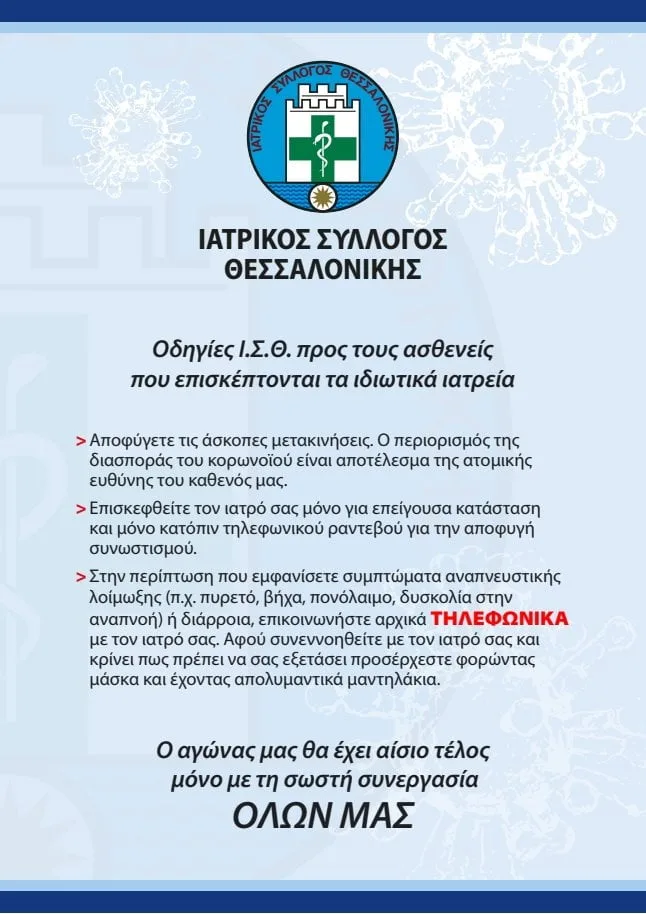
Guidance from the Medical Association of Thessaloniki for patients visiting private practices: >Avoid unnecessary travel. Limiting the spread of the coronavirus is a matter of personal responsibility...

In view of the rising incidence of Covid-19 coronavirus infection and the far-reaching initiatives to limit its spread, ESHRE confirms that the members of the Society...

In 1/3 of infertile couples the cause lies with the man. A man may be, and feel, completely healthy, yet the quality of his sperm may be low. A semen analysis...

With prenatal screening for Down syndrome we try to find out whether the baby has this syndrome as early as possible in pregnancy. Screening tests do not give...

Worldwide, 10-15% of couples of reproductive age have difficulty achieving a pregnancy. Even so, there are women who will only fulfil their dream of having a child with the...

According to the World Health Organization, a couple is considered infertile when they do not conceive after one year of frequent intercourse without contraception. IVF...

THE NEXT STEP
At the first appointment, we discuss your medical history and any concerns you may have, so that together we can review the options available.
or call us at 2310 277 032
FREQUENTLY ASKED QUESTIONS
Infertility is defined as the failure to achieve conception after one year (or 6 months in the case of a woman over the age of 35) of normal, regular sexual intercourse. In other words, when a year has passed without the woman becoming pregnant, the couple should consult their treating physician, so that the cause preventing pregnancy can be identified and subsequently addressed. However, we should all be aware and not forget that age is the most critical factor for female fertility, and that an individualized approach to each couple is the "golden key" that solves the problem.
Of course not. In approximately one third of cases, infertility is due to the woman (female factor), while in another third of cases it is due to the man (male factor). In the remaining third, it is due to both partners (both the man and the woman) or even to unknown factors.
• alcohol • narcotic substances • environmental toxins, including pesticides and lead • smoking • health problems • medications • radiotherapy and chemotherapy • age
In general, specialists agree that the fact that a couple has already had a child may be considered evidence that, at least initially, there is no infertility problem. It is like a small test that has been carried out and shows that they “succeeded” at least once. On the other hand, however, we should be aware that circumstances may have changed in the meantime and that a problem may have developed (e.g., the man may have had an inflammation affecting the quality of his sperm, or something may have occurred that affects female fertility: an inflammation, gynecological surgery, an abortion, etc.). In any case, therefore, if a reasonable period of time (one year) passes and a couple is unable to achieve a pregnancy, then, with the help of their doctor, they should investigate whether a problem causing infertility has arisen.
Success rates vary at each IVF center. Very important factors also include the woman’s age, her hormone levels, and, of course, her husband’s sperm. In general, rates are around 45% or slightly higher for women up to 35 years of age.
The number of treatment cycles a woman may undergo is not fixed. It is certain that in our country there are highly qualified obstetrician-gynecologists and well-organized infertility treatment centers that provide excellent medical services in this field. Provided that the appropriate indications are present (e.g., ovaries that respond to stimulation treatment, a good-quality endometrium, etc.), the success rate—particularly with the use of newer techniques and biotechnological medicines, which demonstrate increased bioactivity compared with conventional urine-derived medicines—reaches a cumulative rate of approximately 65%–70% after 4 treatment cycles.
Egg retrieval takes 10–15 minutes, is not painful, is performed under sedation, and after the procedure is completed you can return to your activities.
The association between IVF medications and the risk of developing cancer is the greatest concern for women participating in these programs. However, numerous literature references gathered from reliable scientific studies and published in reputable medical journals worldwide are reassuring and do not confirm this concern.
At Dr. Traianos' Reproductive Medicine Center, we offer egg and sperm cryopreservation services for individuals who have a personal or medical reason and require this service. We use the most advanced vitrification technique for the freezing of sperm and eggs.